Wednesday, 12 October 2016

Φυσική άμυνα κατά του έιτζ έχει ένα στα δέκα παιδιά


Το ανοσοποιητικό σύστημα των παιδιών είναι πιο ανεκτικό, ενώ κατά την ενηλικίωση γίνεται πολύ πιο επιθετικό.


To ένα δέκατο των παιδιών διαθέτει ένα «παράδοξο» ανοσοποιητικό σύστημα, παρόμοιο με αυτό των πιθήκων, που αποτρέπει την εκδήλωση του έιτζ, αναφέρουν σε μελέτη τους Βρετανοί επιστήμονες.

Στη μελέτη, η οποία δημοσιεύθηκε στην επιθεώρηση Science Translational Medicine, οι ερευνητές διαπίστωσαν ότι το ανοσοποιητικό σύστημα σημαντικού ποσοστού παιδιών παρέμενε σε συνθήκες ηρεμίας παρά την προσβολή τους από τον ιό. Ετσι διασώθηκε και δεν εξουδετερώθηκε ολοκληρωτικά.

Η λοίμωξη από τον ιό του έιτζ, εάν δεν τύχει αποτελεσματικής θεραπείας, θα οδηγήσει στον θάνατο το 60% των παιδιών εντός δυόμισι ετών. Η ίδια λοίμωξη, ωστόσο, στους πιθήκους δεν είναι θανατηφόρα. Οι ερευνητές ελπίζουν ότι οι διαπιστώσεις τους θα οδηγήσουν στην επινόηση και την παρασκευή νέων ανοσοθεραπειών κατά του έιτζ.

Ο ιός του έιτζ είναι θανατηφόρος επειδή καταστρέφει ολοκληρωτικά το ανοσοποιητικό σύστημα, καθιστώντας τον οργανισμό εξαιρετικά ευάλωτο σε άλλες λοιμώξεις.

Οι ερευνητές ανέλυσαν το αίμα 170 παιδιών από τη Νότια Αφρική που είχαν προσβληθεί από τον ιό του έιτζ και μολονότι δεν είχαν λάβει αντιρετροϊκή θεραπεία, δεν είχαν παρουσιάσει τα συμπτώματα της νόσου.

Οι αιματολογικές αναλύσεις έδειξαν ότι διέθεταν δεκάδες χιλιάδες ιούς του έιτζ ανά χιλιοστόμετρο αίματος, κατάσταση που συνήθως θα έκανε το ανοσοποιητικό σύστημα να υπερδραστηριοποιηθεί προσπαθώντας να καταπολεμήσει τη λοίμωξη ή απλά θα τα έκανε να αρρωστήσουν σοβαρά. Τίποτα από τα δύο δεν συνέβη. Οπως επισημαίνει ο καθηγητής Φίλιπ Γκούλντερ, ένας από τους ερευνητές του Πανεπιστημίου της Οξφόρδης, πρακτικά το ανοσοποιητικό σύστημα των παιδιών αγνοεί τον ιό, ενώ όπως τονίζει, το βασικό δίδαγμα της μελέτης είναι ότι το έιτζ αφορά κυρίως την ανοσοποιητική αντίδραση του οργανισμού στον ιό και όχι τόσο τον ίδιο τον ιό. Ο ιός επιτίθεται εναντίον των λευκών αιμοσφαιρίων, των πολεμιστών του ανοσοποιητικού συστήματος και τα καταστρέφει, ενώ η υπέρμετρη δραστηριότητα του ανοσοποιητικού σύστηματος σκοτώνει ακόμα περισσότερα εξαιτίας των χρόνιων επιπέδων φλεγμονής.

Για τους επιστήμονες ο τρόπος που το 10% των παιδιών μπορεί και διαχειρίζεται την προσβολή από τον ιό του έιτζ έχει εξαιρετικά μεγάλες ομοιότητες με τον τρόπο που αντιμετωπίζουν τον αντίστοιχο ιό για τους πιθήκους (SIV) περισσότερα από σαράντα είδη πρωτευόντων. Ομως η αλήθεια είναι ότι τα είδη αυτά είχαν εκατοντάδες χιλιάδες έτη εξέλιξης για να αναπτύξουν τρόπους άμυνας έναντι της λοίμωξης. «Η φυσική επιλογή λειτούργησε σε αυτές τις περιπτώσεις των πρωτευόντων. Ο μηχανισμός που ακολουθείται έχει μεγάλες ομοιότητες με αυτό που συμβαίνει στο 10% των παιδιών όπου η μόλυνση δεν εξελίσσεται», τονίζει ο καθηγητής Γκούλντερ.

Αποκλειστικά στα παιδιά

Ωστόσο, πρέπει να σημειωθεί ότι η άμυνα έναντι του ιού του έιτζ περιορίζεται αποκλειστικά στα παιδιά. Το ανοσοποιητικό σύστημα των ενηλίκων ενεργοποιείται στο μέγιστο των δυνατοτήτων του προκειμένου να σκοτώσει τον ιό εισβολέα.

Πρόκειται για μία πολεμική εκστρατεία που σχεδόν πάντα καταλήγει σε αποτυχία. Η αλήθεια είναι ότι το ανοσοποιητικό σύστημα των μικρών παιδιών είναι πιο ανεκτικό, ενώ κατά την ενηλικίωση γίνεται πολύ πιο επιθετικό. Γι’ αυτόν ακριβώς τον λόγο, η ανεμοβλογιά είναι πολύ πιο βαριά στους ενηλίκους. Ετσι αυτά τα παιδιά που έχουν τη φυσική άμυνα έναντι του έιτζ, όταν μεγαλώσουν και ωριμάσει το ανοσοποιητικό τους σύστημα, κινδυνεύουν να εμφανίσουν την ασθένεια. Κάποια παιδιά, βέβαια, διατηρούν την ανοσία τους.

Τέλος, στο κύριο άρθρο που συνοδεύει τη μελέτη στην επιστημονική επιθεώρηση οι Αμερικανοί γιατροί του Πανεπιστημίου Εμορι τονίζουν ότι δεν είναι γνωστό πόσο σώφρον είναι τα παιδιά που εμφανίζονται να έχουν προστασία έναντι του ιού να μένουν χωρίς θεραπεία.


ΠΗΓΗ:
http://www.kathimerini.gr/877086/article/epikairothta/ygeia/fysikh-amyna-kata-toy-eitz-exei-ena-sta-deka-paidia(accessed 12.10.16)

Sunday, 9 October 2016

The Age At Which Learning a New Language Stops Strengthening The Brain


How learning a new language changes the brain.

Learning a new language improves both the brain’s structure and its function, whatever your age, new studies find.


Scientists now think new language learning causes surprising anatomical changes in the brain — much greater than was previously thought.

Professor Ping Li, who led the study, published in the Journal of Neurolinguistics, said:


“Learning and practicing something, for instance a second language, strengthens the brain.

Like physical exercise, the more you use specific areas of your brain, the more it grows and gets stronger.”

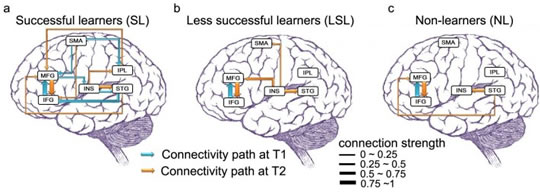
In one study, researchers followed 39 English-speakers as they tried to learn some Chinese over six weeks (Yang et al., 2014).

Their brains were scanned before and afterwards to measure anatomical and functional changes in the brain.

These scans were compared with those of a control group.

The results demonstrated that those who successfully retained the information had more efficient neural networks across important functional areas (below).


A second study, which Professor Li was also involved in, found that second language learning resulted in changes in the brain across all age-groups (Li et al., 2014).

Whether children, adults, or the elderly, learning another language causes rapid improvements in gray matter density and white matter integrity.

Professor Li said:


“A very interesting finding is that, contrary to previous studies, the brain is much more plastic than we thought.

We can still see anatomical changes in the brain [in the elderly], which is very encouraging news for aging.

And learning a new language can help lead to more graceful aging.”


SOURCE:
http://www.spring.org.uk/2014/12/the-age-at-which-learning-a-new-language-stops-strengthening-the-brain.php(accessed 9.10.16)

The causes and consequences of thinking there’s an office conspiracy


We’re all familiar with gossip in the workplace, both the benign variety – did you know Tom is applying for X-Factor? – as well as more serious talk concerned with perceived injustices, such as the real reason for that recent promotion. When such speculations insinuate a group working together to achieve secret ends, we’re into the realm of conspiracy theory. New research in theBritish Journal of Psychology suggests that conspiracy theories about the workplace are a thermometer for an employee’s broader feelings about the organisation … including his or her ultimate commitment to it.

It’s already known from past research that people with a conspiratorial mindset can pose problems for organisations because they tend to distrust authority and have a Machiavellian mindset. Building on this, Karen Douglas of the University of Kent and Ana Leite of the University of Roehampton wanted to know if belief specifically in workplace conspiracies has its own unique influence.

They asked 209 working adults recruited online to report how wedded they were to their current organisation, and to rate their conspiracy beliefs: in general conspiracies such as September 11 being an inside job, and in what really goes on in their organisation, rating their agreement with items such as “a small group of people secretly manipulates events”.

Just as prior work has found, participants with a generally conspiratorial mindset were more likely to intend leaving their organisation. But controlling for this tendency, conspiracy beliefs specific to the workplace had a unique association with intent to leave the organisation. Conspiracy believers who considered leaving were also likely to have less emotional commitment towards the organisation, not seeing it as a family worth sticking with, and also had lower job satisfaction.

One way to interpret this is that believing that powerful cliques are playing games indifferent to – or even hostile to – your interests is a powerful turnoff for feeling that your work, or your membership to the organisation, has any meaning. However, as this study can’t establish causality, you could make an alternative argument: that conspiracy theories don’t dampen enthusiasm, it’s simply that people who are bitter and already planning to leave are willing to entertain far-fetched ideas to justify their disenchantment.

To settle this, Douglas and Leite asked 202 more participants (from the same online survey site) to imagine working in an organisation where a conspiracy seemed to be going on, made specific using examples such as a stitch-up for the employee of the year award by a faction in management. Compared to control participants who imagined a conspiracy-free organisation, participants imagining a stitch-up reported that they would be less committed, enjoy their job less, and would be more likely to leave the fictional organisation.

This appears to provide evidence that belief in workplace conspiracies actually causes negative outcomes, but I wish the article provided a summary of the instructions in the two conditions, as on the face of it, they don’t seem ideally matched – after all, regardless of your psychological response to conspiracies, there are good reasons to consider leaving an organisation if you think a PR-disaster might be on the horizon. Nevertheless the study does show that exposure to a conspiracy leads to the same psychological consequences as in the field sample.

In a further study with 119 workers from another online site, Douglas and Leite also found evidence for the kind of workplace that is likely to foster a work-conspiracy mindset. Participants were asked to imagine working for a large consultancy, either a version of it where staff had little autonomy, few chances to benefit, and there was lots of conflict, or a positive version that flipped these qualities. Those in the negative climate condition were much more likely to endorse conspiracy beliefs about the (fictional) workplace, and they showed the same pattern of lower commitment and job satisfaction and a greater readiness to leave. As in broader research on conspiracy theorising, these participants seemed to find bitter solace in secret explanations that could make sense of the lack of control with which they were confronted.

Although this research focuses on the problem end of workplace conspiracy theory, Douglas and Leite point out that there is a flip side: vigilance towards corruption, a willingness to bring power-holders to account, and a desire for transparency are all healthy facets of organisational participation. Things become most corrosive when conspiracies are found where there are none, misdirecting energy and causing breakdowns between echelons who, when working together, could do so much more.

SOURCE:

https://digest.bps.org.uk/2016/09/15/the-causes-and-consequences-of-thinking-theres-an-office-conspiracy/(accessed 9.10.16)

Wednesday, 5 October 2016

New clues about the way memory works in infancy


Can we form memories when we are very young? Humans and non-humans alike show an “infantile amnesic period” – we have no memory of anything that happens during this time (usually up to age three or four in humans) which might suggest we can’t form very early memories. But of course it might be that we can form memories in these early years, it’s just that they are later forgotten. The idea that at least something is retained from infancy is consistent with the fact that disorders present in adult life can be associated with very early life events.

Now Nature Neuroscience has published a paper confirming that in rats some kind of memories arecreated during the amnesic period, but that these operate differently and are produced by different brain chemistry from adult memories. What’s more, such events may have a role in kickstarting memory system maturation.

The research team from University of New York and Mount Sinai Hospital looked at rats aged either 17 or 24 days – the former still in the infantile amnesic period and who I’ll henceforth refer to as infants, the latter grown to non-amnesic status – and specifically how they were affected by the experience of being electrically shocked when exploring a novel, dark chamber adjoining their brighter home.

The infant rats showed almost no indication of being able to retain a memory of the shock. Given the chance, they sometimes returned to the chamber within the next 30 minutes, And after 24 hours, any memory of the unpleasant experience seemed entirely absent, in that they showed no hesitation in re-entering the chamber. This suggests that, at least in rats, infantile amnesia in due to a failure to store memories in the first place.

But with further tests, Alessio Travaglia’s team showed that some kind of memory had in fact been formed. First they gave the rats an opportunity to wander back into the chamber, which was now a safe place (again they were happy to do this, suggesting they’d forgotten the earlier shocks). A few days later the researchers gave the rats a shock in a different location – crucially, after this unpleasant experience, the rats showed a new, persistent (days long) reluctance to enter the dark chamber when given the chance, even though it was now safe. It’s as if a memory of the earlier shocks in the chamber had been reawakened by the later shocks somewhere else.

What was going on? Firstly, whatever was happening involved the hippocampus, a brain structure involved in the laying down of normal memories in mature brains. We know this because, just before the initial shocks, the researchers used a chemical to block normal functioning in the hippocampus of some rats, and for these animals, no amount of jogging and reminders were able to bring back any indication of remembering.

The researchers also uncovered some signs of learning and memory in the infant rats’ brains at a molecular level. Infant rats have less of a specific version of a chemical receptor in their hippocampus than mature rats. Analysing the extracts of brain tissue taken from the trained infant rats showed that after the initial training shocks in the dark chamber, they showed a sudden increase in this specific receptor (an effect not seen in the mature rats).

Let’s make sense of this. Imagine that we enter the world with just a pared-down version of memory, appropriate to being newborn, where the necessities of life, milk and warmth, are just there without you having to understand much about the world. Within weeks, this system is to be superseded by one using the same functional circuitry but fine-tuned, ready to capture novel information and store it accessibly. Until then, the system operates in a bare way, but still preserves what it can about significant events. Crucially, such events accelerate the transition to the full system, by triggering the development of more of the chemical receptors that are seen in adults. It’s too late to capture an accurate memory of this threat – the horse has bolted – but the brain gets busy building a better stable for the next one.

We don’t know, of course, whether still earlier stages in the amnesic period involve the capacity to capture memory information – it’s hard to do this kind of work with animals too small to explore their environment. But this new research suggests that in rats, and likely in infant humans too, the system is far more active than expected, not only retaining some information (which the researchers dub a “latent memory” to account for it’s difficulty in retrieval) but also acting as a developmental critical period, akin to the way infant visual systems begin to change themselves in response to light. Given this sensitivity, the researchers speculate that early wrong experiences – or deprivation from experience – may harm us in later life through an upset of this critical period, and may contribute to neuropsychiatric disorders as a consequence.

SOURCE:
https://digest.bps.org.uk/2016/09/13/new-clues-about-the-way-memory-works-in-infancy/(accessed 5.10.16)

Saturday, 1 October 2016

Η μοναξιά είναι γενετική σε ποσοστό 14% έως 27%


Ανάμεσα σε όσα μπορεί κανείς να κληρονομήσει από τους γονείς του είναι και η μοναξιά σύμφωνα με μια νέα αμερικανική επιστημονική έρευνα που διαπίστωσε ότι τα γονίδια ενός ανθρώπου μπορούν να τον προδιαθέσουν, ώστε να γίνει πιο μοναχικός. Η επίδραση του περιβάλλοντος πάντως παίζει σαφώς μεγαλύτερο ρόλο για την πρόκληση μοναξιάς.

Και άλλες μελέτες στο παρελθόν έχουν καταλήξει σε παρόμοια συμπεράσματα. Η νέα μελέτη εκτιμά ότι η μοναξιά είναι σε ποσοστό 14% έως 27% γενετική, ενώ προηγούμενες εκτιμήσεις είχαν ανεβάσει τη γενετική συμβολή σε 37% έως 55%, ποσοστά όμως που θεωρούνται υπερβολικά.

Οι ερευνητές, με επικεφαλής τον καθηγητή ψυχιατρικής Άμπραχαμ Πάλμερ της Ιατρικής Σχολής του Πανεπιστημίου της Καλιφόρνια-Σαν Ντιέγκο, που έκαναν τη δημοσίευση στο περιοδικό νευροψυχοφαρμακολογίας «Neuropsychopharmacology», ανέλυσαν γενετικά και ιατρικά δεδομένα για σχεδόν 10.800 ανθρώπους ηλικίας άνω των 50 ετών, οι οποίοι επιπλέον κλήθηκαν να απαντήσουν σε ερωτηματολόγια για το πόσα χρόνια (όχι περιστασιακή) μοναξιά ένιωθαν.

Η μελέτη κατέληξε στη διαπίστωση ότι σε μερικούς ανθρώπους η μοναξιά τείνει να κληρονομείται μαζί με τον νευρωτισμό και τα συμπτώματα κατάθλιψης. Πιο ασθενής είναι η συσχέτιση της κληρονομικής μοναξιάς με τη σχιζοφρένεια και τη διπολική διαταραχή. Πάντως μέχρι στιγμής δεν έχει εντοπισθεί κάποιο συγκεκριμένο γονίδιο της μοναξιάς.

Η μοναξιά σχετίζεται με χειρότερη σωματική και ψυχική υγεία, πράγμα που αυξάνει τον κίνδυνο για πρόωρο θάνατο, περισσότερο και από την παχυσαρκία.

Από την άλλη, η μοναξιά βιώνεται διαφορετικά από τους ανθρώπους και για ορισμένους αποτελεί πολύ μεγαλύτερο πρόβλημα από ό,τι για άλλους. Όπως είπε ο Πάλμερ, αυτό ακριβώς μπορεί να οφείλεται στο ότι κάποιος έχει γενετική προδιάθεση για μοναξιά, ενώ κάποιος άλλος όχι.


Πηγή: 

http://www.askitis.gr/psychichealth/view/%CE%B1%CE%BA%CF%8C%CE%BC%CE%B1-%CE%BA%CE%B1%CE%B9-%CE%B7-%CE%BC%CE%BF%CE%BD%CE%B1%CE%BE%CE%B9%CE%AC-%CE%BA%CE%BB%CE%B7%CF%81%CE%BF%CE%BD%CE%BF%CE%BC%CE%B5%CE%AF%CF%84%CE%B1%CE%B9(accessed 1.10.16)