Wednesday, 24 May 2017

6 Signs You Are Dealing With A Narcissist


How to tell the difference between a narcissist and someone who just has high self-esteem.


1. Brittle self-esteem

One thing everyone notices about the narcissist is that they appear very full of themselves and self-centred.

But, some people are full of themselves because they simply have high self-esteem, and possibly for good reason.

The narcissist, though, feels they are superior to others, but at the same time not very satisfied with themselves.

Their self-esteem is brittle, ready to crack and reveal the uncertainties underneath.

At their core, they can feel a certain lack, which is why they are…
2. Susceptible to flattery

The narcissist loves nothing better than when others gather round to tell them how great they are.


And narcissists believe every single word of even the most exaggerated flattery.


While others take it with a pinch of salt, the narcissist laps it all up, believing they are only getting their due.

The reason they are so susceptible to flattery is that their ambition knows no bounds.

They really believe they are royalty.

If you don’t offer flattery to the narcissist, they will start to solicit it from you: “What do you think of my hair today, doesn’t it look nice?”
3. A big production

Narcissists love to make a big production out of everything.

They can turn on the charm in an instant.

It’s why they appear so often on reality TV shows, and TV and entertainment in general.

They adore attention and will do anything to get it from others.

This makes them very attractive, at least initially.

Their antics provide a welcome break from the workaday world.

Watching a narcissist is very entertaining…

…until, of course, they turn…


4. Envious

Most people experience the odd burst of envy from time-to-time, but for the narcissist envy burns brightly.

Narcissists are deeply involved with how they are doing in comparison to others.

This means they get pleasure from devaluing others and from showing how much better they are themselves.

Naturally, then, they are competitive and likely to be poor losers.
5. Lack of empathy

The narcissist cares little for how others feel, they are only interested in getting their own needs met.

And their own needs are simple enough: to be worshipped as a living God.

Some narcissists can be very manipulative in order to get what they want.

They take advantage and think little of others’ feelings.

Then, when they have satisfied their egos, it is all over as if nothing happened.
6. Volatile

Some narcissists fit in reasonably well with society.

‘Successful’ narcissists manage to maintain their jobs and relationships by keeping their tendencies in check.

For the more volatile narcissist, though, their narcissism escapes in most situations.

They immediately blow up at even the slightest criticism.

Their envy, insecurity and vanity boils over at every available opportunity.

The effect is to push people away, tired of being used and abused.

So the narcissist ends up continually seeking new friends and a new audience, after the old ones have got fed up with their antics.


SOURCE:
http://www.spring.org.uk/2017/05/signs-narcissist.php(accessed 24.5.17)

Οι παράξενες «παρενέργειες» του σεξ


Το γέλιο, το κλάμα, το φτάρνισμα και η φαγούρα είναι μερικές μόνο από τις ασυνήθιστες «παρενέργειες» που εμφανίζονται μετά την ολοκλήρωση της σεξουαλικής πράξης και τις οποίες οι επιστήμονες περιγράφουν με τον όρο «περι-οργασμός».


Μια νέα επιστημονική μελέτη που δημοσιεύεται στην επιθεώρηση Sexual Medicine Reviews έβαλε στο μικροσκόπιο αυτό το παράδοξο φαινόμενο της σεξουαλικής ζωής και κατέληξε σε εξαιρετικά ενδιαφέροντα συμπεράσματα.

Σύμφωνα με τους δύο ερευνητές που πραγματοποίησαν τη μελέτη, την Άννα Ρέινερτ από το Πανεπιστήμιο του Μέριλαντ και τον Τζέιμς Σάιμον από το Πανεπιστήμιο Τζορτζ Ουάσινγκτον, ως περι-οργασμικά φαινόμενα ορίζονται τα «ασυνήθιστα σωματικά ή ψυχολογικά υποκειμενικά συμπτώματα που βιώνουν κάποια άτομα στο πλαίσιο της οργασμικής τους απόκρισης και που διαφέρουν από τη συνήθη ή τη φυσιολογική οργασμική απόκριση».

Με τη βοήθεια ειδικών σε θέματα σεξουαλικής υγείας, οι δύο ερευνητές αρχικά έφτιαξαν μια λίστα με περι-οργασμικά συμπτώματα και στη συνέχεια, με τη λίστα σαν «οδηγό», αναζήτησαν τέτοια περιστατικά σε δημοσιευμένα επιστημονικά άρθρα.

Το συμπέρασμα: Ο περι-οργασμός είναι πέρα για πέρα υπαρκτός και τα περι-οργασμικά συμπτώματα παρουσιάζουν μεγάλη ποικιλία, αφού περιλαμβάνουν, μεταξύ άλλων, την καταπληξία (αιφνίδια μυϊκή αδυναμία), το κλάμα, τη δυσφορία, τον πόνο στο πρόσωπο και/ή στο αυτί, τον πόνο στο πέλμα, τον πονοκέφαλο, τη φαγούρα, το γέλιο, την κρίση πανικού, το φτάρνισμα και το σύνδρομο μετα-οργασμικής νόσου.

Οι δύο ερευνητές ευελπιστούν πως τα ευρήματά τους θα εμπνεύσουν και άλλους επιστήμονες να εξετάσουν περαιτέρω το φαινόμενο του περι-οργασμού, ρίχνοντας ενδεχομένως περισσότερο φως στους νευροφυσιολογικούς μηχανισμούς που το καθοδηγούν.


ΠΗΓΗ:
http://www.koutipandoras.gr/article/oi-paraenes-parenergeies-toy-se(accessed 24.5.17)


Sunday, 21 May 2017

Treating children with electroconvulsive therapy


Electroconvulsive therapy - in which a small electric current is passed through the brain causing a seizure - is now used much less often than it was in the middle of the last century. But controversially it is now being used in the US and some other countries as a treatment for children who exhibit severe, self-injuring behaviour.

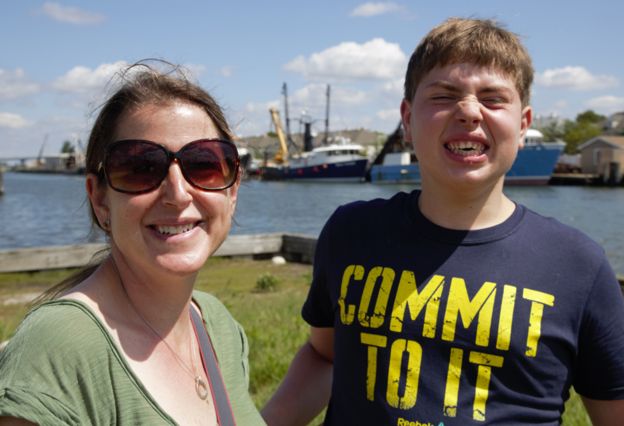
Seventeen-year-old Jonah Lutz is severely autistic. He's also prone to outbursts of violent behaviour, in which he sometimes hits himself repeatedly.

His mother, Amy, is convinced that if it wasn't for electroconvulsive therapy - ECT - he would now have to be permanently institutionalised for his own safety, and the safety of those around him.

The use of ECT featured famously in the 1975 Hollywood movie, One Flew Over the Cuckoo's Nest, starring Jack Nicholson. Set in a mental institution, the Oscar-winning film cemented most people's view of ECT as barbaric.

But Amy describes the modern version of the therapy as little short of miraculous.

"ECT has been transformative for Jonah's life and for our life," she says. "We went for a period of time - for years and years - where Jonah was raging, often multiple times a day, ferociously. The only reason he's able to be at home with us, is because of ECT."

It's estimated that one in 10 severely autistic children like Jonah violently attack themselves, often causing serious injuries ranging from broken noses to detached retinas. No-one really knows why. Some theories link self-injuring behaviour to anxiety caused by an overload of sensory signals, others to frustration as the autistic child struggles to communicate.

Amy and husband Andy tried countless traditional treatments using medication or behavioural therapy before finally turning to ECT - a treatment that first began to be used on children like Jonah a decade ago, in parts of the US. Each session alleviates his symptoms for up to 10 days at a time - but it's not a cure.

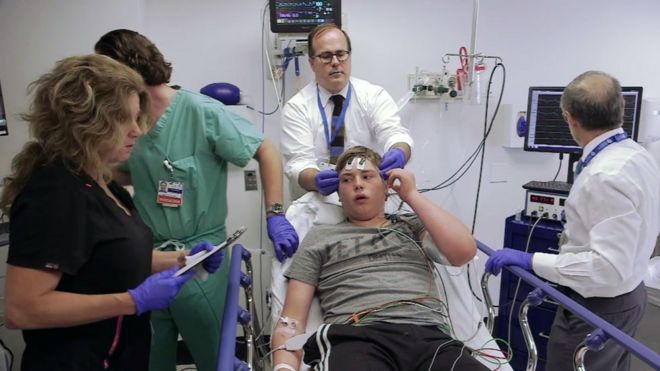
Jonah's doctor, Charles Kellner, ECT director at Mount Sinai Hospital in New York, is so convinced it's effective and safe that he allows Amy to witness the procedure and the BBC to film it.

Prof Kellner says the best way to overcome the negative image of ECT portrayed in popular culture is "to show people what modern ECT is really like, and show them the results with patients like Jonah".

Jonah is one of a few hundred children in the US to receive the controversial treatment. He has had about 260 ECT sessions since the age of 11.
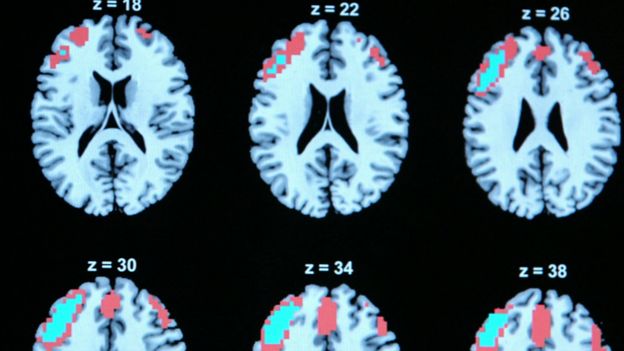
"There's a lot of interesting new neural imaging research showing that ECT actually reverses some of the brain problems in the major psychiatric illnesses," Kellner explains, as he makes final checks on the wiring around Jonah's temples.

"We don't know exactly why it works in people with autism and superimposed mood disorders, but we think it probably reregulates the circuits in the brain that are deregulated because of autism."

The modern treatment is carried out under general anaesthetic, with muscle relaxants to prevent violent convulsions. At the flick of a switch, Kellner administers just under an amp of electric current in a series of very short pulses.

Jonah's body begins to shake as the current induces a seizure - ECT specialists think this may "reset" the malfunctioning brain. The convulsions last for about 30 seconds.

Amy is unperturbed by what she sees.

"If a doctor says they need to cut open your child's chest to conduct life-saving surgery, you would allow it. That is more barbaric yet we accept it," she says.

Within an hour Jonah is fully alert. He and his mother head out of the hospital and on to the New York street to find an ice cream parlour.
Find out more
Viewers in the UK can watch Chris Rogers's Our World documentary My Child, ECT, and Me on the BBC News Channel on Saturday 20 May or Sunday 21 May - click here for transmission times or to watch online
Viewers outside the UK can watch it on BBC World News over the coming week - click here for transmission times

Because the long-term effects of ECT on children exhibiting self-injuring behaviour are unknown, in some countries - and in a handful of US states - the treatment is not allowed. The UK's National Institute for Health and Care Excellence doesn't recommend ECT for use on under 18s.

But ECT is a well-established treatment in adults for severe, often life-threatening depression. Its use is controversial, though, with memory loss the main acknowledged side-effect. What's disputed is the scale of the memory loss. Studies carried out by ECT doctors suggest lapses are mostly short-term and that memory function soon returns to normal. But opponents of ECT cite surveys claiming to show that more than half of patients suffer serious long-term memory loss.

"It's a traumatic brain injury," says Dr Peter Breggin, a psychiatrist who has long fought the psychiatric establishment, and campaigns for a total ban on ECT. "The electricity not only travels through the frontal lobes - that's the seat of intelligence, and thoughtfulness and creativity and judgment - it also goes through the temporal lobes - the seat of memory. You are damaging the very expression of the personality, the character, the individuality, and even, if you believe in it, the expression of the soul."

For former US Army intelligence officer Chad Calvaresi and his wife Kaci, the potential benefits of ECT far outweigh the risks for their 11-year-old, violently autistic daughter, Sofija.

"When she was aggressing towards me, my instinct as a mom was to grab her and hold her and hug her and wait," Kaci explains. "But she got so big and strong that I couldn't do that."

Sofija spent much of her early life suffering neglect and abuse in a Serbian orphanage, before Chad and Kaci adopted her in 2009. They were determined to give her a better life in America, but in 2016 they suffered the heartbreak of institutionalising her again - this time for her own safety.

"She beat herself so bad her nose was busted and bleeding, her lips were busted open and bleeding," Chad explains. "She gave herself a black eye. I was scared of my own daughter."

For six months Sofija received medication and therapy as an in-patient at the renowned Kennedy Krieger Institute in Baltimore, but there was little improvement. During her frequent violent episodes it often took three highly trained care staff - all wearing protective clothing and shielding Sofija with padded mats - to prevent her injuring herself or others.

After exhausting all other options, Sofija's doctors finally agreed to Chad and Kaci's request to give her ECT. Just a month later her behaviour had improved enough for her to return home.

We caught up with the family after six months and more than 30 treatments, and the transformation was remarkable. Sofija was swimming in the family pool and playing with her siblings, and while her violent episodes hadn't disappeared completely, her parents felt they were less intense and more manageable. Sofija was also receiving home schooling in maths and English. "She's sharp as a tack," says Kaci. "The only memory loss that Sofija has had from ECT is she forgets the procedure has actually happened."

ECT for severely self-injuring autistic children like Sofija is still in very limited use, and without a long-term scientific study it remains highly controversial. But even though Sofija is likely to need ECT every week for the foreseeable future, her parents have no regrets - they have their daughter back home.

"It's overwhelming if I think about it," says Kaci, "but what future did she have without it? My hope is she doesn't need it for the rest of her life but at this point I see it like a diabetic needing insulin. It keeps her alive. Literally it keeps her alive and it makes it possible for us to be able to have her in our home living life with our family and enjoying Sofija."Image captionSofija enjoys a maths lesson at home

For and against ECT

The Royal College of Psychiatrists says ECT is a "safe and effective treatment for severe depression" in adults but acknowledges on its website that some dispute this:

For

Many doctors and nurses will say that they have seen ECT relieve very severe depressive illnesses when other treatments have failed. Bearing in mind that 15% of people with severe depression will kill themselves, they feel that ECT has saved patients' lives, and therefore the overall benefits are greater than the risks. Some people who have had ECT will agree, and may even ask for it if they find themselves becoming depressed again.

Against

Some see ECT as a treatment that belongs to the past. They say that the side-effects are severe and that psychiatrists have, either accidentally or deliberately, ignored how severe they can be. They say that ECT permanently damages both the brain and the mind, and if it does work at all, does so in a way that is ultimately harmful for the patient. Some would want to see it banned.

SOURCE:

http://www.bbc.com/news/magazine-39961472(accessed 21.5.17)

New studies suggest liberals are as blinkered and biased as conservatives


Officially at least, last week’s global March for Science was politically neutral. However, there’s a massive over-representation of people with liberal, left-leaning views in science, and much of the science community is unhappy, to put it mildly, with the way politics is going, such as the Trump administration’s proposed deep cuts to science funding, and here in the UK, the impact of Brexit on British science.

Against the backdrop of these anxieties, many of the banners on display – such as “Alternative hypotheses, not alternative facts” and “Science reveals the truth” – conveyed a barely concealed message: if only right-wing conservatives could be a little more objective, less biased, more open-minded – you might say a little more “scientific” – then the world would be a better place.

Plenty of past psychology research lends some credence to this perspective: for instance conservatives tend to score lower on the trait of open-mindedness than liberals, and of course conservatives, more often than liberals, are sceptical toward the scientific consensus that human activity has had a significant impact on climate change. But it’s also easy to find psychological evidence of liberals’ bias, and liberals too are often in denial of unwelcome scientific theory, such as evolutionary accounts of sex differences in behaviour.

Now two new articles, published at the Social Science Research Network (SSRN) and in the Journal of Experimental Social Psychology, respectively, provide further compelling evidence that liberals, as much as conservatives, are prone to partisan bias – that is, showing rapid, easy acceptance of evidence that supports their existing beliefs – and that they are just as motivated to avoid hearing viewpoints that differ from their own. Whether we’re liberal or conservative, a first step toward combating our political prejudices, the paper in SSRN concludes, is “to recognize our collective vulnerability to perceiving the world in ways that validate our political beliefs”.


That paper in SSRN is a meta-analysis that combined the results of 41 previous experimental studies into partisan bias, collectively involving over 12,000 participants self-categorized as either liberal or conservative.

Each of the included studies followed a similar format: participants rated the credibility of evidence, such as a survey, experiment or op-ed, which either supported or contradicted their existing beliefs, such as on gun ownership or affirmative action. By holding the quality of the evidence and methods the same, but altering whether it supposedly came up with data supporting or contradicting participants’ viewpoints, this kind of research is able to reveal partisan bias – that is, whether participants’ are less sceptical and discerning when confronted with evidence that backs their own views.

Looking at the combined data from all these studies, Peter Ditto at University of California, Irvine, and his colleagues, found that liberals were as prone to partisan bias as conservatives. What’s more, partisan bias on all sides was especially on display when participants were presented with scientific data, perhaps undermining the chants of the science march: that it might be easier to reach political consensus if we could all agree to just stick to the facts. As Ditto and his team put it, “the prognosis for eradicating partisan bias with harder data and better education does not seem particularly rosy.”

The other new paper, led by Jeremy Frimer at the University of Winnipeg, used five studies to test American and Canadian participants’ motivation to encounter viewpoints different from their own. For instance, the first study offered participants more money to read an essay that contradicted their own views on same-sex marriage. The researchers found that equally among liberals and conservatives, a majority of participants preferred to forego cash if that meant avoiding opposing views.

Other studies involving other topics, such as gun control, abortion and climate change, led to similar results: liberals as much as conservatives were disinclined to hear the perspective of the other side. And the reasons they gave were similar: they thought hearing opposing views would make them feel uncomfortable or angry and harm their relationship with the source of the opposing views.

“The result of this desire to avoid ideological incongruous views is that liberals and conservatives live in ideological information bubbles, and what could ultimately be a contest of ideas is being replaced by two, non-interacting monopolies,” Frimer and his colleagues concluded.

This new research has some short-comings and shouldn’t be seen as the last word. It’s obviously North-American centric, and it’s not clear how much the results would apply in other parts of the world. It’s also extremely difficult to separate the moral dimension from psychology research into politics: for instance, how to deal with the potential argument that avoiding exposure to some opinions actually is more justified than avoiding exposure to others?

So of course more careful research is required, into ways that liberals and conservatives are similar and different. But if these new studies help us recognise that we all, no matter our political colours, could work harder to be more open-minded of opposing viewpoints, then this is surely constructive. As Sean Blanda put it in a Medium essay last year “The other side is not dumb“; well, probably no more than your side anyway.


SOURCE:

https://digest.bps.org.uk/2017/04/25/new-studies-suggest-liberals-are-as-blinkered-and-biased-as-conservatives/(accessed 21.5.17)

Sunday, 14 May 2017

10 Ways That Running Changes Your Mind and Brain


“One 60-minute run can add 7 hours to your life” claimed The Times last week. The story was based on a new review in Progress in Cardiovascular Diseases that concluded that runners live, on average, three years longer than non-runners and that running will do more for your longevity than any other form of exercise. But there’s more to running than its health-enhancing effects. Research published in recent years has shown that donning your trainers and pounding the hills or pavements changes your brain and mind in some intriguing ways, from increasing connectivity between key functional hubs, to helping you regulate your emotions. The precise effects sometimes vary according to whether you engage in intense sprints or long-distance running. Here, to coincide with a new feature article in The Psychologist – “Minds run free” – we provide a handy digest of the ways that running changes your mind and brain.


Running changes your brain wiring
David Raichlen and his colleagues scanned the brains of young, competitive distance runners and controls while they rested in a scanner with their eyes open for six minutes. As reported in Frontiers in Human Neuroscience, the runners showed greater connectivity between the so-called frontal parietal network and other neural regions involved in working memory and self-control, which the researchers interpreted as likely due to the cognitive demands of running and the runners’ increased aerobic fitness. The runners also showed greater “anti-correlation” between their default mode network (the DMN, which sparks into life when we’re resting) and a series of regions involved in motor control and sensation – the researchers said this could indicate that when on the move, the runners are likely to be very cognitively engaged, with their DMN suppressed.

Intense sprints seem to boost your executive function
For a study published last year in Preventive Medicine Reports, researchers asked young volunteers (average age 12) to complete several 10-second sprints for ten minutes and then take some cognitive tests. The participants acted as their own controls and on another day (either before or after the sprint day) they completed the same mental tests after 10 minutes of rest. The participants’ performance on the Stroop Test – a long-established measure of mental control or what psychologists call “executive function” – seemed to be enhanced immediately after the sprints and 45 minutes afterwards, as compared with after resting. There were no effects of the sprints on visual-spatial memory performance or basic mental speed (as judged by the Digit Symbol Substitution test). Based on their finding of an apparent benefit of sprints on executive function, Simon Cooper and his colleagues said there was a case for including more opportunities for intense exercise in the school day.

Seven weeks of interval running training can boost your cognitive flexibility
For three times per week for seven weeks, a small group of young dinghy sailors spent 45 minutes per session, rising to 90 minutes at the end of the programme, engaged in interval training: running fast for between 200 to 1000m, interspersed with periods of rest. The researchers tested their volunteers’ cognitive function before the training period and afterwards, and compared the outcomes with a control group of young dinghy sailors who just continued their active lifestyle as usual. Writing in The Journal of Strength and Conditioning Research, Tomas Venckunas and his colleagues reported that the running group didn’t just get fitter and better at running, but also showed superior gains in their cognitive flexibility: that is, they were better at adapting to rapid switches in task instructions in a keypress task on a computer.

Ridiculously extreme long-distance running shrinks your brain (but it grows back)
In 2009, 67 endurance athletes ran nearly 3,000 miles over 64 days, without a single day’s rest, to complete the TransEurope-FootRace ultramarathon. For a paper in BMC Medicine, a team of researchers led by Wolfgang Freund scanned the brains of a sample of these runners before the race, during and eight months afterwards. During the race, the runners’ brains shrunk, in terms of grey matter volume, by about six per cent, an amount that the researchers described as “substantial” considering that normal aging is associated with volume loss of around 0.2 per cent per year. However, at the final scan, the runners’ brains had recovered to their pre-race volume. In a follow-up study in BMC Sports Science, Medicine and Rehabilitation, the same research team pinpointed the running-related grey matter loss to four key areas, including parts of: temporoparietal cortex, occipitotemporal cortex, anterior cingulate and prefrontal cortex, and caudate nucleus. Although highly speculative, they noted the overlap of these areas with the Default Mode Network and suggested the observed cell loss in these regions may reflect the combination of the metabolic demands of running combined with a prolonged lack of use of the DMN, the brain’s resting-state network.

The “runners’ high” may be linked to changes in brain chemicals
Completing a run can leave you feeling euphoric and several studies suggest this could be down to changes to the brain’s chemical messengers. For instance, a 2008 study in Cerebral Cortex used PET neuroimaging to show that a two-hour run led to enhanced opioid binding across several areas of the brain, as compared with before the run, and that this was associated with subjective feelings of euphoria. This supports the idea that running triggers the increased released of endorphins in the brain – a kind of natural high. A more recent paper in the Journal of Experimental Biology pointed to the importance of other neurotransmitters: the researchers found that an intense treadmill run, but not a walk, was associated with increased circulation of endocannabinoids – endogenous brain chemicals that bind to the same receptors in the brain as cannabis.

Running may quieten your mind
Anecdotally, many runners also say that going for a jog has a calming effect, helping their brains dial back on usual levels of worry and rumination. A study published last year in Experimental Brain Research appeared to provide some partial scientific support for this idea. Petra Wollseiffen and her colleagues used electroencephalography (EEG) to measure the surface electrical activity of the brains of 11 ultramarathoners several times during a six hour run. Running was associated with reductions in activity in the frontal cortex of the brain, and for the first hour, runners also reported feeling more relaxed and an increased sense of “flow”. However, the levels of decreased brain activity and subjective feelings of flow didn’t correlate so it would be an oversimplification to say that this research shows that running helps you to relax by switching off your brain.

Running increases the growth of new neurons (at least in mice)
It was the received wisdom through most of the last century that adults can’t grow new neurons – a process called neurogenesis. It’s now known that this isn’t true: in fact, new neurons continue to grow through life in specific areas of the brain. Interest has turned to the function of these news neurons and ways to encourage their growth. To date, much of the research is on rats and mice, in whom a recurring finding is that running seems to encourage neurogenesis. Take a seminal paper published in Nature in 1999. Fred Gage and his team reported that mice who had the opportunity to choose to run in a spinning wheel exhibited twice the amount of neurogenesis in a part of the hippocampus (a brain region involved in memory and learning), as compared with mice who had no choice but to swim or others who had to complete a water maze. More recent animal research suggests that it is particularly long-distance running, as opposed to interval-style training (short bursts of running) that may increase neurogenesis, perhaps through release of what’s known as “brain derived neurotrophic factor (BDNF)”, a chemical that encourages cell growth.

A short jog may help you regulate your emotions
For a 2015 study in Cognition and Emotion, Emily Bernstein and Richard McNally asked volunteers to jog or stretch for 30 minutes and then they showed them a sad clip from the film The Champ. Participants who said they usually struggled to handle negative emotion were more intensely affected by the sad clip, just as you’d expect, but crucially this was less so if they had completed the jog (but not the stretching). The researchers said: “… a bout of moderate aerobic exercise appears to have helped those participants potentially more vulnerable to problematic affective dysregulation to be less susceptible to the impact or lingering effects of the stressor”.

Intense sprints may boost your ability to learn
Bernward Winter and his colleagues tested participants’ ability to learn new made-up words for objects after either two intense sprints of three-minutes length, after 40 minutes of gentle running, or after resting. Participants were able to learn 20 per cent faster after the sprints compared with the other conditions, and they showed superior memory retention when tested again a week later. Writing in the Neurobiology of Learning and Memory, the researchers said the blood measures they took suggested that the participants’ enhanced learning performance after sprints may have been associated with increased levels of dopamine, epinephrine, norepinephrine and BDNF. “This [finding] is pertinent to the organization of learning-supportive environments, e.g., in schools (intense exercise during the breaks),” the researchers said.

Running a marathon seems to wipe your memory of the pain
Let’s not romanticise long-distance running. As Daniel Engber observed at Slate last year, “a vast, disturbing literature has now accumulated on the ill effects of running marathons”, particularly all the pain, including chaffing, blisters and cramps. One way that repeat marathon runners seem to cope is that the satisfaction of completing a run gradually wipes their memories for the pain they went through. Researchers demonstrated this for a study published in Memory: they asked marathon runners to report their pain and emotions directly after completing a marathon and then caught up with them again six months later, to ask them to recall their earlier post-marathon pain. The runners tended to have forgotten just how much pain they’d been in, and this was especially true if they’d been on an emotional high at the end of the marathon.

SOURCE:
https://digest.bps.org.uk/2017/04/19/10-ways-that-running-changes-your-mind-and-brain/(accessed 14.5.17)